Looking back on "Watching The English"

Updated: Jul 26
The "Watching the English" pilot project was launched in April. As the project's creator and a psychologist, my idea was to bring together people with similar experiences of adapting to English culture. And it worked!
During our group meetings, we discuss chapters of the book, share our thoughts and similar experiences, and practise English (the meetings are held entirely in English). This unique combination of activities helps us create, together, a safe space where we can analyse anthropological theories and discuss hypotheses on the one hand, while also feeling free to explore our own emotions and personal experiences on the other. In my view, the most valuable thing the group offers is the feeling that you are not alone — and that there is nothing wrong with you or with the world around you.
That said, there is no emphasis on therapy, because the group is not intended to be a therapeutic one. Depending on the topic and on how comfortable you feel, you can always stay at the level of the book itself without becoming more personal or sharing your own stories. In practice, however, we have found the opposite to be true. People naturally long for connection. We all want others to be present, to recognise our experiences, and to validate our feelings. The group meets these needs simply by giving people a place where they can come together.
Participants are asked to make one commitment: to keep the discussion focused on the topic so that everyone has the opportunity to take part. That does, of course, mean keeping up with the reading! Every Sunday brings a new chapter. Some people read the paperback, happily rustling its pages, while others listen to the audiobook. One of the most fascinating parts of our discussions is discovering where our perceptions overlap and where they differ. Sometimes we even find ourselves wondering: are all the conclusions Kate Fox reached over the course of nearly twenty years of research still as relevant today? We think. We talk. We listen — and we truly hear one another. We accept different perspectives and treat each other with respect.
As the group's facilitator, it brings me enormous joy to see the same people returning week after week, having been with us since the very first page of the book. It's already clear that the experiment has been a success, and that the project will not end with this book alone. The title, however, fits us so perfectly that we'll most likely keep it. Watching the English. There's something special about it.
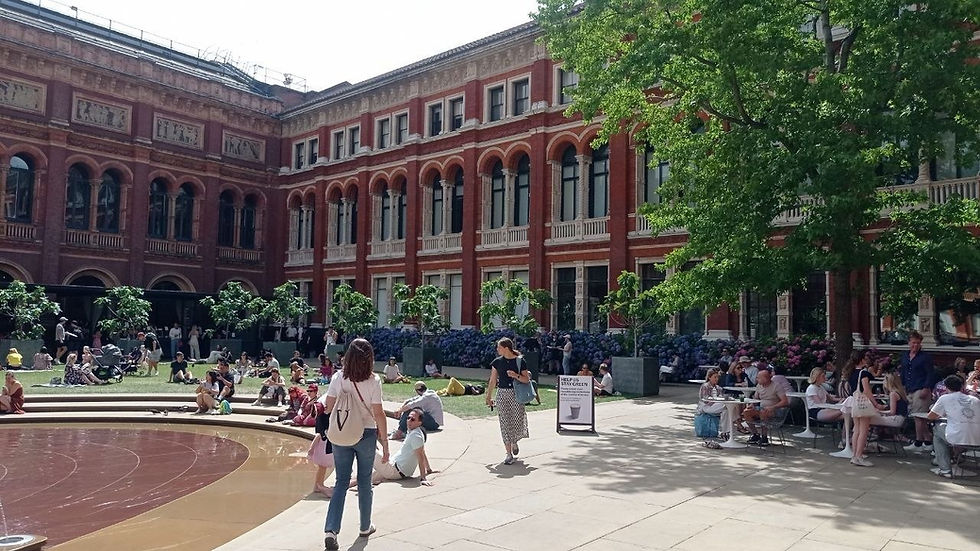
Our book discussions have gradually evolved into a private club. On the last Sunday of June, we held our first offline gathering in London. Since we were discussing the chapter about food, we decided not only to talk about it but to experience it ourselves by organising a Food Safari in London. We also have a special bonus session planned for July, when we finish the book. We'll be joined by someone from the local culture, who will share an English perspective on Kate Fox's work and answer all the questions we've accumulated over the months. Incidentally, some people joke that for many Britons, Kate Fox's book is a substitute for therapy!
Looking ahead, we'll continue reading together, watching films, inviting English guests to our meetings, discussing and experiencing local culture firsthand, and unravelling the mysteries of the English character together.
To become part of our private WTE (Watching the English) club, all you need to do is attend our regular Sunday meetings (announced on Eventbrite), join the discussions, read along with us, and share your thoughts. At the end of the summer, we're planning a group hike. We'll walk along the coast while talking about the local cultural code. We've also made a promise to ourselves that one day we'll find a guide, buy proper hats, and finally experience those famous horse races for ourselves. After all, they seem to represent a very particular art of being English. 🐎
Perhaps the most interesting thing of all is that the purpose of the club is not to become more like the English. By noticing cultural differences and peculiarities, we end up learning not only about them, but also about ourselves. It's an adventure in self-discovery. And practising English helps us integrate more confidently into life here. Once we've reflected on our experiences through the lens of cultural differences, it becomes much easier to talk about them with partners, colleagues, and friends.
If you live in England, are interested in British culture, or simply want to practise your English, keep an eye on our Eventbrite announcements and join us for our Sunday discussions and offline events. We'll finish reading Kate Fox's book in July, and together we'll choose our next book — or perhaps a film or TV series.
You don't have to wait for the next announcement to get involved. You can apply to join our cultural club today by emailing events@rusdemsociety.co.uk with the subject line "Cultural Club". Don't forget to include your contact details—the organisers will get in touch with you.