Russian Democratic Society 2025 report

Updated: Dec 23, 2025
2025 marks the fourth year of the full-scale war in Ukraine. It is also the fourth year of the Russian Democratic Society’s existence. This year was full of events and memorable moments for us. Our team expanded and changed significantly, we launched new projects, and organised many events. We achieved especially much in our work with UK government bodies and international organisations: together with the launch of the Russia and Democracy APPG, we reached a qualitatively new level. But even while working on large-scale projects at the state level, we never forget that everything we do is aimed at protecting the interests of Russians and achieving a just end to the war in Ukraine.
In 2026, we will continue working on the projects launched in 2025 and also hope to bring you new initiatives. We will talk in more detail about the results of the year for our organisation and about our plans in this report. But before that, we invite you to make a wish for the coming year together with us: may the war end, and may Russia finally return to the path of democracy.
Team composition and structure
In short:
Updated the team composition
Formalised the RDS structure
Created an internal code of ethics
Plan: continue recruiting new team members
In detail:
This year brought many changes to the RDS team: several key members decided to leave. We are grateful to everyone who worked at RDS over the past four years and wish them success in all their future projects and endeavors! For us, this meant restructuring processes and recruiting new people into RDS. More than half of those who are now actively working on our projects joined the organisation during 2025. New activists always bring fresh perspectives and new ideas — and we are glad to see that applications to join the RDS team are still coming in. In the coming year, we hope to welcome even more new activists and continue expanding our ranks. If you want to help us, feel free to fill out the form via the link. We would be especially happy to see people who are ready to work in SMM or help with the production and distribution of anti-war and pro-democracy merchandise.
Expanding the team also meant new challenges for us, and we reformed RDS’s internal system of work by clarifying the internal structure and updating our code of ethics. We hope that these changes will prove effective and sustainable in the coming year and will help us continue implementing our projects and initiatives.

Events and cooperation with other organisations
In short:
Organised two protests (on the anniversary of the start of the full-scale invasion and in support of the singer Naoko)
Held two events with public speakers
Repeatedly collaborated with other anti-war and opposition organisations of Russians (and not only!) in the UK
Expanded our network of contacts, which we plan to continue using next year
Planned several major events for 2026
In detail:
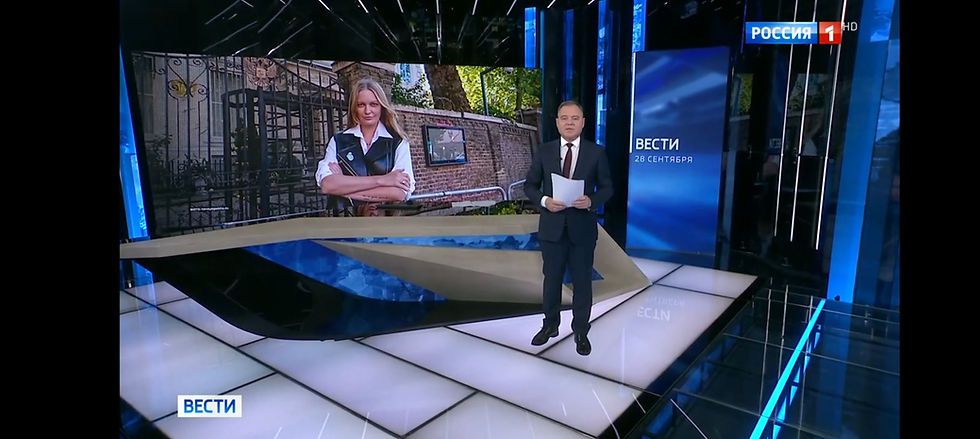
Despite significant changes in the team composition and our strong focus on building internal strategies this year, organising events and working with other organisations remained one of the most important areas of our activity. Once again, we organised a protest on the anniversary of the start of the full-scale invasion in February, and later also held a protest outside the Russian Embassy in October in support of the singer Naoko and members of the band “Stoptime,” who were arrested in St. Petersburg for publicly performing songs by “foreign agents.” Although protests are no longer as central to RDS’s work as they were four years ago, we were glad to see so many concerned people who came to express their disagreement with the aggressive and repressive policies of the Putin regime.
In addition, we held two events with invited speakers — educator and writer Dima Zitser and queer blogger Sonya Svinopanda. We also took part in other events, including evenings of letter-writing to political prisoners and screenings of anti-war films. We have already begun work on several large events that we plan to hold next year — and we hope there will be even more of them!
In 2025, we also worked closely with other organisations and activists — the Feminist Anti-War Resistance, Yasnaya Britannia, Navalny’s Team, Memorial, and the organisers of letter-writing evenings for political prisoners. Our activists joined protests and actions organised by colleagues — including a rally on the anniversary of Alexei Navalny’s murder, a feminist march, and a queer protest. We hope to continue this tradition in the new year and to build friendships with even more organisations in order to develop joint initiatives.
Engagement with governmental and international organisations
In short:
Helped launch the All-party Parliamentary group on Russia and Democracy (Russia and Democracy APPG)
Strengthened ties in Europe and the United States
Participated in international conferences
Built relationships with Ukraine and Ukrainian organisations through trips to Kyiv
Began work in the field of sanctions against the Putin regime, which we plan to continue next year
In detail:
This year became a year of coming of age for the RDS Government Relations team. We started as a small, overstretched volunteer group and by the end of the year had become a clear and in-demand interlocutor for decision-makers on Russia and the war in Europe, the UK, the United States, and Ukraine. This was the result of many meetings, correspondence, prepared documents, and ongoing dialogue between the Russian diaspora and the institutions shaping policy.
In the UK, we established sustainable contacts with MPs from different parties, helped launch the All-party Parliamentary group on Russia and Democracy, and responded to questions about sanctions and public opinion inside Russia. At the same time, we strengthened ties in Europe and sought to establish initial contacts with the United States. Participation in major conferences in London and Brussels made it possible to integrate the voices of anti-war Russians into a broader conversation about European security, sanctions, and the role of the diaspora. In particular, we took part in the Alliance of Liberals and Democrats for Europe (ALDE) conference in Brussels, conferences by RUSI and “Defenders of Freedom” in the UK, the GLOBSEC conference in Prague, as well as two conferences of the Antiwar Committee.
Of particular importance were the trips of RDS Director Ksenia Maksimova to Kyiv — in July, when an expert roundtable was held, and in October, when a meeting of representatives of the Verkhovna Rada of Ukraine and the UK Parliament took place. Personal meetings with Ukrainian experts and politicians helped us better understand Ukraine’s context and expectations, and therefore formulate our positions more precisely in dialogue with European governments.
Another important area of work was expert analysis on sanctions against the Putin regime, including research into the role of major service companies in supporting Russian oil extraction. The results of this research are already being used in dialogue with colleagues from other organizations. We will continue to develop our analytical work, as well as support projects related to the UK Parliament, strengthen ties with Ukraine, and expand our network of contacts in Europe and the United States.

SMM and newsletter
In short:
Revived the RDS newsletter — for general and expert audiences
Created the “Russian Realities” column on Instagram
Plan: revive other social media platforms
In detail:
For our SMM team, the year was not an easy one: several of our activists left the team for various reasons. Nevertheless, our two main communication channels — Telegram (1,350 subscribers) and Instagram (3,660 subscribers) — continued their uninterrupted work of informing our readers. On Instagram, we even launched a new column, “Russian Realities,” for English-speaking audiences: every Sunday we publish five news items from Russia in order to give the international audience a more comprehensive understanding of Russian realities and political pressure on civil society in the Russian Federation. In addition to maintaining our existing social networks and projects, our plans for 2026 include resuming regular activity on Twitter (X) and Facebook to reach an even wider audience.
In addition, this year we restored our newsletter and by the end of the year fully streamlined its publication process. It now arrives reliably and monthly in subscribers’ inboxes in the final days of each month — with news, plans, and illustrations. Moreover, the newsletter has two versions: one for a general audience and one for experts. The first is written in Russian and English. It has five sections: news, plans, fundraising, analytical texts, and a cultural guide. The expert newsletter, in turn, is written only in English and consists of three parts: news, plans, and analytical texts. Every month we collect materials, write texts, translate, edit, and design — all under tight deadlines. This year we sent out 11 general newsletters and 9 expert ones, and our goal for the next year — of course — is 12 and 12.
Community support
In short:
Created a new RDS department, currently focused on psychological and emotional support
Held an in-person meeting in London with a psychologist combined with a letter-writing evening
Created a support group, held 10 meetings, recruitment is ongoing
Plan: new meetings and formats
In detail:
In the summer of this year, practicing counselling psychologist Evgenia Pushkaryova joined our team, and thanks to her, RDS developed an entirely new area of work related to psychological support for members of the Russian-speaking community in the UK. In August, during a letter-writing evening for political prisoners, a meeting with Evgenia was organised that focused on adaptation strategies for immigrants. After that, a closed, dynamic emotional support group was launched, and recruitment for it is ongoing — applications can be submitted via the link. The group has already held 10 meetings and will continue its work next year.
The community support department is the newest, but it already plays an important role in RDS’s work. Next year, new meetings and support formats for the Russian-speaking community in the UK are to be expected, which we have already begun developing — in particular, English language classes are currently being prepared. If you would like to join existing initiatives or propose your own idea in this area, we would be happy to welcome you to our ranks!
Website
In short:
Changed the homepage
Synchronised the website with Instagram
Added a blog section
Updated information
In detail:
In case you didn’t know, RDS has its own website. This year, we optimised it and made it more user-friendly. First, we updated the homepage — it is now easy to navigate from there to all key sections. Second, we synchronised the website with our Instagram page, so all of our posts there can now also be seen on the site. Third, a blog section appeared: for now, it contains one text — our statement regarding the EU decision to restrict the issuance of visas to Russians. But next year, our blog can be expected to expand, with more materials published there. Finally, we removed outdated and irrelevant information and updated the texts describing our organisation. Next year, we will continue improving the website and making it more convenient, but even now we are proud of the work done and will be glad if you visit it more often!